Why Your Swings Feel Heavier in the First Set of a Cold Session
Quick Answer: Three things. Cold muscle produces force more slowly, and a swing is a rate-of-force task rather than a strength task, so it is disproportionately affected. Cold cast iron is genuinely harder to grip - the metal draws heat from your hand, grip strength falls, and you compensate by squeezing, which fatigues the forearms early. And your hip hinge has less range when tissue is cold, so the swing gets shorter and more quad-driven, which feels heavier for the same load. Twelve minutes of proper warm-up and a bell stored indoors fixes most of it.
The bell did not change. Your rate of force development and your grip did.

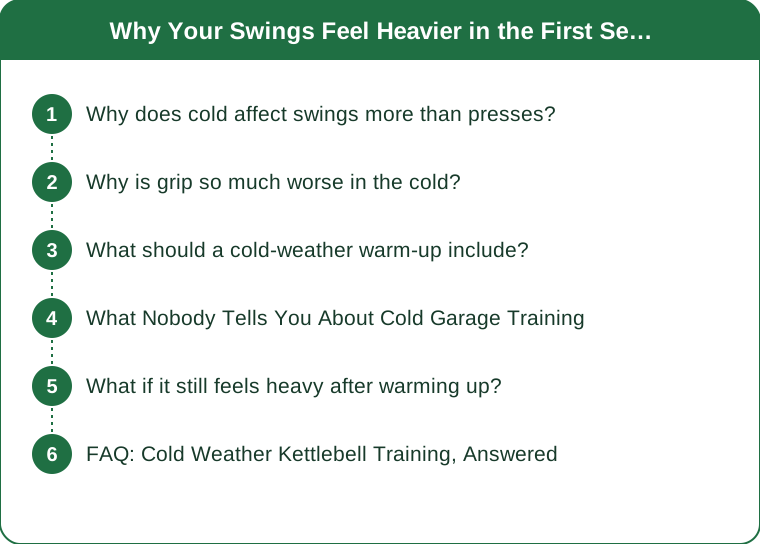
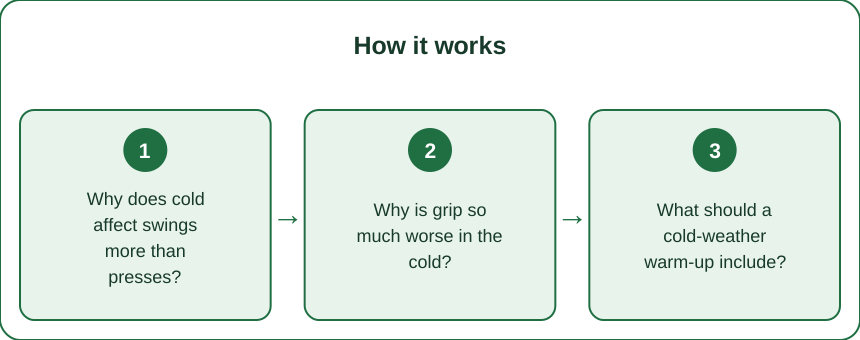
Why does cold affect swings more than presses?
Because a swing is a ballistic movement and cold hurts speed more than strength. Rate of force development - how fast you can produce force - drops more with cooling than maximal force does.
The hip snap is the whole exercise. If the hips fire slower, the bell floats less, and you end up lifting it with the arms and shoulders, which is much harder work.
A slow press is far less affected because it does not depend on speed. This is why people notice cold on swings, cleans, and snatches while their presses feel normal.
Tendon stiffness changes too. Cold tendons store and return less elastic energy, and the backswing-to-hip-snap transition relies on that return.
The compensation is what you actually feel. A slower hip snap produces an arm-driven swing, and arm-driven swings feel enormously heavier at the same weight.
And the fix is warm-up, not a lighter bell. Going lighter in the first set is fine, but the underlying issue is temperature and it responds to warming up rather than to deloading.
Why is grip so much worse in the cold?
Cast iron conducts heat away from your hand fast. A bell stored at 8C in a garage pulls heat from your palm within seconds, and grip strength falls measurably as hand temperature drops.
Reduced tactile feedback makes you grip harder. When you cannot feel the handle well, you squeeze - and a death grip on a swing fatigues the forearms in a fraction of the usual time.
Cold hands crack and tear more easily. Dry autumn air plus cold metal plus friction is the classic setup for a torn callus.
Bring the bell indoors, or warm the handle. Wrapping the handle in your hands for thirty seconds, or running it under warm water and drying it, makes a real difference.
Chalk still helps, and gloves usually do not. Gloves add material thickness, which increases effective handle diameter and makes grip harder rather than easier.
And do your grip warm-up deliberately - hangs, bell holds, or simply carrying the bell for thirty seconds before the first set.
What should a cold-weather warm-up include?
Five minutes of general movement first. Something that raises your temperature - fast walking, jumping jacks, easy rowing. Not stretching.
Then hip hinge specific work. Good mornings with no weight, hip hinges to a wall, glute bridges. The hinge is what is restricted when cold and it needs its own attention.
Then thoracic and lat work. The backswing needs shoulder extension, and cold shoulders shorten the backswing, which shortens the whole movement.
Then two to three light sets of swings. Half your working weight for ten, then three-quarters for ten. This is not wasted volume, it is the actual warm-up for the pattern.
Then grip: thirty seconds of holding the working bell.
Total: about twelve minutes. In summer six would do. Cutting the warm-up because the session is short is the most common reason people tweak a back on swings in autumn.

What Nobody Tells You About Cold Garage Training
Chalk behaves differently in cold, dry air - it is drier and less grippy on a cold handle, and many people find they need less of it, not more.
The floor is the coldest thing in the room, and any exercise that involves lying on it is significantly less appealing in October. Accessory work quietly disappears from garage sessions from about week two of autumn.
Bells store energy from the room. A bell that has been indoors is warm to the touch and stays comfortable throughout a session; one from a cold garage never fully warms up during a workout.
Cold makes you rush the warm-up, which is exactly backwards - standing around getting cold feels bad, so people skip straight to work sets.
A small fan heater run for fifteen minutes before you train changes the whole session and costs very little. Heating the space in advance beats heating it during.
And breathing matters. Cold dry air is harsh in high-rep ballistic work, and many people find hard swing sets much less pleasant in a cold garage for airway reasons alone.
What if it still feels heavy after warming up?
Check the hinge depth on video. A shortened hinge is the most common autumn technique change and it is invisible from the inside.
Check whether you are wearing more clothing. A hoodie restricts the backswing and changes the arm path, and it is a common unnoticed variable.
Check the surface. Trainers with a compressible sole on a cold hard floor changes the feel of the drive; flat shoes or bare feet are better for swings.
Check sleep and food before you check the programme. Autumn brings a lot of confounders, and one heavy session is not a signal.
Consider that it may just be a bad day. Two bad sessions is data; one is noise.
And do not chase the previous weight. Doing a good session at ninety percent beats a bad one at a hundred, and swings performed badly are one of the faster routes to an irritated lower back.
This is general information, not medical advice.
FAQ: Cold Weather Kettlebell Training, Answered
How long should a cold-weather warm-up be?
About twelve minutes, roughly double a summer warm-up, with specific hip hinge and grip work included.
Should I store my kettlebells indoors?
Ideally yes, at least the ones you use most. A cold bell hurts grip and never warms up during a session.
Do gloves help with cold bells?
Usually not - they increase effective handle thickness and reduce feel, both of which make grip harder. Warming the handle works better.
Why do my forearms burn out early in winter?
Cold hands mean reduced feel, which means over-gripping. Warm the handle and consciously grip only as hard as needed.
Should I lower the weight in cold weather?
For the first sets, yes. If it still feels heavy after a full warm-up, check hinge depth and clothing before changing the programme.
TL;DR:
- Swings are a rate-of-force task, and cold reduces speed of force production more than it reduces strength.
- A slower hip snap makes the swing arm-driven, which feels dramatically heavier at the same weight.
- Cold cast iron drains heat from your hands, reducing grip strength and causing over-gripping and early forearm fatigue.
- Warm up for about twelve minutes with specific hip hinge, thoracic, and grip work - roughly double what summer needs.
- Store bells indoors and heat the space for fifteen minutes beforehand; both are cheap and both work.
If it still feels heavy after a full warm-up, film your hinge depth and check whether a hoodie is shortening your backswing.
Keep Reading
This article is for general informational and styling purposes only. Fit, sizing, and product availability may vary.