Why Your Kettlebell Clean Bangs Your Forearm Every Time
Quick Answer: The bell bangs your forearm because it is traveling in an arc away from your body and then dropping onto your wrist, instead of traveling in a tight vertical path close to your torso. The fixes are to guide the bell inside rather than let it swing outside, to spear your hand through the handle rather than let the bell rotate around it, and to accept the bell with a soft, slightly bent knee rather than a locked, upright body.
Every beginner gets told the same thing about kettlebell cleans. It takes time. Everyone bruises at first. You will get it eventually.
Half of that is true. What nobody mentions is that if you are still bruising after a few weeks, you are drilling one of four specific errors into your nervous system, and more repetitions will make it more permanent rather than less.
Bruising is information. Here is how to read it.

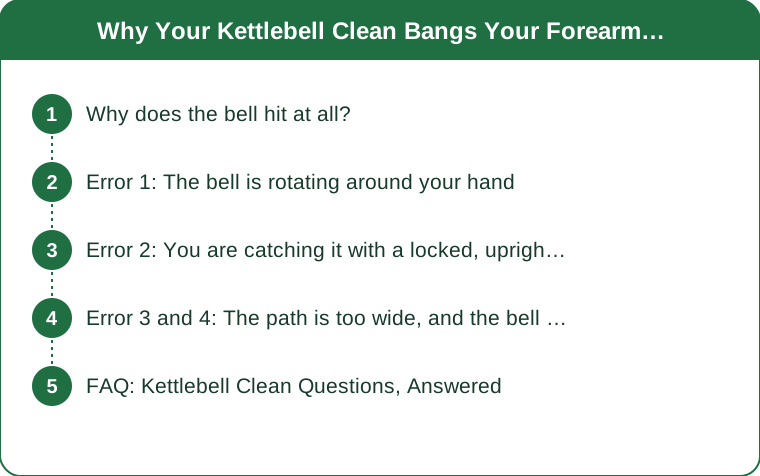
Why does the bell hit at all?
Because you are cleaning it like a swing.
In a swing, the bell travels away from your body in a wide arc — that arc is the point of the movement. In a clean, the bell must travel almost vertically, staying close to your torso the whole way up. Every centimeter it drifts forward is a centimeter it has to travel back toward you at the top, and it covers that distance fast, with your forearm in the way.
So the mechanical cause is nearly always the same: too much horizontal force and not enough vertical guidance. The hip drive is correct; what is missing is the arm’s job of keeping the bell on a tight path.
The most useful mental correction is that in a clean, the arm is not passive. In a swing it mostly is. In a clean, the arm actively steers the bell inward and upward, like zipping a jacket up the front of your body. If your cue for the clean is the same as your cue for the swing, this is the whole problem.
Error 1: The bell is rotating around your hand
Watch a slow-motion clip of a bruising clean and you will usually see the bell flip over the top of the fist and land on the wrist.
What should happen instead is that your hand spears through the handle as the bell rises. The handle rotates in your grip while your hand travels through it, so the bell arrives already resting in position rather than falling into it.
The drill: hold the bell at your side, hanging from the handle. Without letting the bell move, rotate your hand so your thumb points backward. Now curl it up to the rack. You will notice the bell has nowhere to fall from — it is already where it needs to be.
That is the position your hand needs to reach on the way up, not after arrival. Practice ten slow, deliberate reps with a light bell before doing any at speed. The grip must also loosen at the top — a death grip forces the bell to swing around a fixed hand instead of the hand moving through the handle.

Error 2: You are catching it with a locked, upright body
The second most common cause, and it is about deceleration.
If you stand fully upright with locked knees at the moment the bell arrives, all of the bell’s downward momentum has to be absorbed by your forearm. There is nowhere else for it to go.
The correction is to meet the bell with a slightly bent knee and a fractionally lowered body, then stand up as the bell settles. This gives you a few centimeters of travel to absorb the momentum, and it is what makes an experienced lifter’s clean look silent.
A useful cue: catch the bell, then finish standing. Most beginners finish standing and then catch the bell, which is the same order of operations reversed and it costs them a bruise every rep.
The same principle applies at the elbow. The elbow should be driving down and into the ribs as the bell arrives, connecting to your torso. A floating elbow means an unsupported forearm.
Error 3 and 4: The path is too wide, and the bell is too heavy
The wide path. If the bell swings out in front of you before coming up, you have a swing-then-curl, not a clean. The fix is a change in where the hike starts. Hike the bell back higher and closer, aiming it at your upper thigh rather than out in front, and keep your forearm brushing the inside of your thigh on the way up. Some coaches teach it with a literal contact cue: the thumb should graze the crease of your hip.
A useful correction drill is the dead clean — starting each rep from the floor rather than from a backswing. Without momentum you cannot rely on the arc, so you are forced to find the vertical path. Three sets of five dead cleans per side per session will rebuild the pattern faster than anything else.
The bell is too heavy. The unglamorous one. Kettlebell cleans are a coordination skill before they are a strength exercise, and a bell you can swing comfortably is often too heavy to clean cleanly. Drop 4 to 8kg for two weeks while you rebuild the pattern. Almost nobody wants to do this and it is almost always the fastest fix.
What nobody tells you about the bruising itself: consistent forearm bruising in the same spot is not just cosmetic. Repeated impact over the same area of the distal forearm is irritating soft tissue that has very little padding, and lifters who train through it for months sometimes develop persistent tenderness that outlasts the technique problem. Fix the pattern before it becomes a tissue problem.
This is general information, not medical advice. Persistent forearm pain that does not settle with rest is worth having looked at.
FAQ: Kettlebell Clean Questions, Answered
Should I wear a wrist guard or a sleeve while I learn?
A sleeve is fine as protection while you are actively correcting your technique, but it should be temporary. Padding removes the feedback that tells you whether the rep was clean, and lifters who train in guards long-term often plateau at a technique level that the padding is hiding.
How long should it take to stop bruising?
With deliberate practice on the dead clean and a lighter bell, most people stop bruising within two to three weeks. If you are past a month of consistent practice and still bruising every session, film yourself from the side — the error is almost always visible in the first frame after the hike.
Is a double kettlebell clean harder on the forearms?
It is actually often easier, because two bells naturally guide each other into a tighter path and give your elbows an obvious place to land against the ribs. Many lifters who struggle with the single clean find the double version clicks first. Just start lighter than you expect.
TL;DR:
- Bruising means the bell is traveling in a wide arc and dropping onto your wrist instead of rising on a tight vertical path.
- Spear your hand through the handle so the bell arrives in position rather than falling into it.
- Catch with a soft, slightly bent knee and finish standing afterwards, not before.
- Hike the bell high and close, with the thumb grazing the hip crease.
- Drill dead cleans from the floor, and drop 4 to 8kg for two weeks while the pattern rebuilds.
Keep Reading
This article is for general informational and styling purposes only. Fit, sizing, and product availability may vary.