Why Two Kettlebells Are Harder Than Twice One Kettlebell
Quick Answer: Single-bell work lets your body counterbalance — you lean away, shift your hips, and let the other side stabilise. With two bells, that option disappears entirely, so your trunk and breathing muscles must produce the stability your posture used to provide. Add a compressed rack position that restricts breathing, and doubles typically feel 30 to 40 percent harder than the arithmetic suggests. Start at roughly 70 percent of your single-bell weight.
You have been pressing a 16 kilo bell for months. Solid, clean, five reps a side.
Then you pick up two 16s, clean them to the rack, and the press does not happen. Not close. And you stand there recalculating, because the load per arm is identical.
The load per arm is identical. Almost nothing else is.

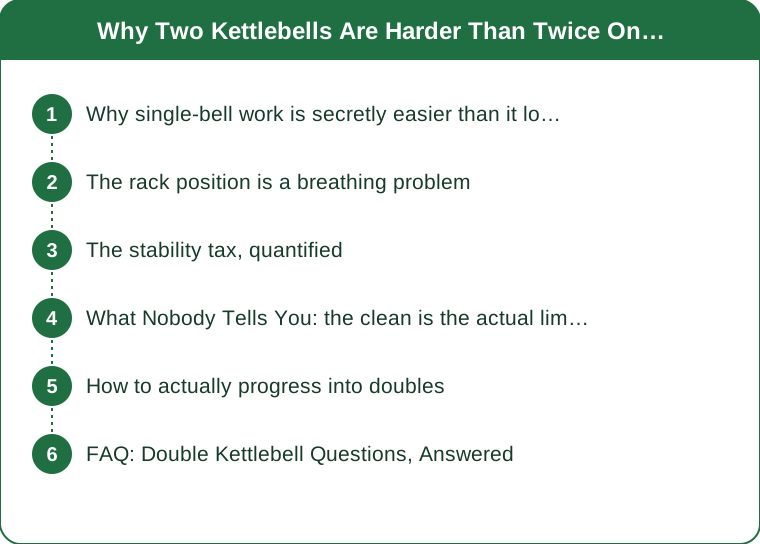
Why single-bell work is secretly easier than it looks
When you hold one kettlebell, your body does something clever without asking permission: it counterbalances.
A bell racked on the left shifts your centre of mass left. Your body compensates by shifting the hips right and side-bending slightly. The result is a system where the load is partly managed by skeletal position rather than by muscular effort.
This is efficient and largely unconscious. It is also why a single-bell overhead press or front squat feels manageable at weights that seem surprising.
The free side is doing work too. Your empty arm acts as a counterweight and, more importantly, gives your trunk an asymmetric anchor to brace against. Watch anyone do a heavy single-bell overhead press and you will see the free arm extend out to the side — that is not style, it is mechanics.
With two bells, both of these disappear. The load is symmetric, so there is nothing to lean away from. The free arm is holding a kettlebell. Everything that was being handled by position is now handled by muscle.
The rack position is a breathing problem
This is the part people underestimate, and it is the biggest single factor.
In a double rack, two bells sit across your chest and forearms, pressed into your ribcage. That is not a neutral position. It is a compressive load directly on the structure you breathe with.
Rib expansion is restricted. Diaphragm excursion is reduced. And you are simultaneously asking for maximum trunk bracing, which further limits how much air you can move.
The practical consequence: in a set of double front squats, most people fail on breathing before their legs give out. The set ends because you cannot get air, not because the load was too heavy.
What to do about it:
- Breathe into the back and sides of the ribs, not the front. The front is occupied. This is a learnable skill and it makes an immediate difference.
- Use short, sharp exhales at the top of each rep rather than trying for a full breath.
- Keep double sets shorter than single-bell sets. Three to five reps is a productive range for doubles; ten is usually a breathing test rather than a strength one.
- Rack the bells slightly wider — bells resting more on the forearms and less crushed into the sternum. A small adjustment that buys a surprising amount of air.
The stability tax, quantified
The trunk demand roughly doubles, and it changes character.
Single bell: the challenge is anti-lateral-flexion — resisting being pulled sideways. Your obliques on the opposite side do most of the work, and there is a clear direction to brace against.
Double bells: the challenge is anti-extension and compression — resisting being folded backwards and staying tall under a load that pushes straight down through the spine. This engages the whole trunk simultaneously and offers no direction to lean.
There is also a coordination cost. Two bells must move together. Any asymmetry in timing means one bell arrives before the other, and the mismatch has to be absorbed by your trunk mid-rep.
The commonly cited rule of thumb: most people can handle doubles at around 70 percent of the weight they use for the same single-bell exercise. If you press a 20 kilo single, start doubles with two 14s or two 16s.
And expect the ratio to differ by lift. Double front squats usually tolerate a higher percentage than double presses, because the legs have more capacity in reserve. The press is where the gap is widest.

What Nobody Tells You: the clean is the actual limiter
People plan a double press session and discover the session ends before the pressing starts.
Cleaning two bells is significantly harder than cleaning one, for a reason that has nothing to do with strength: you cannot use your free hand to guide, and you cannot stagger the timing.
A single-bell clean allows a small amount of steering. Two bells must travel simultaneously, land simultaneously, and rotate around the wrists at the same moment. Get it slightly wrong and you take two bells to the forearms instead of one.
The consequence for programming: if you do five cleans to get into position for five presses, you have done ten demanding movements, and the clean was the harder one.
How to work around it:
- Clean once, then press for reps from the rack. This is the standard approach and it removes most of the problem.
- Practise the double clean as its own exercise at a lighter weight, on a different day, until the timing is automatic.
- Use dead cleans — one clean per rep from the floor — deliberately as a conditioning tool, not accidentally as a tax on your pressing.
- Wear long sleeves for the first few sessions. Genuinely. Forearm bruising is the standard rite of passage and it puts people off before the technique clicks.
How to actually progress into doubles
Start with the front squat, not the press. Legs have more capacity and the squat teaches you the rack position and the breathing constraint without the added overhead stability demand.
Then the double deadlift or double swing — heavy, straightforward, and it builds tolerance for the load without technical complexity.
Then the double press. By this point the rack is familiar and breathing is sorted.
Then double cleans as their own skill.
Weight progression: start at roughly 70 percent of your single-bell working weight and add from there. Two bells the same weight is standard; mismatched pairs work fine for a transition period if that is what you own.
Volume: keep sets at 3 to 5 reps initially and rest fully. Doubles are dense — a set of five double front squats is genuinely more total work than ten single-bell reps per side, done in less time and with a much larger breathing cost.
One session a week is enough to start. The limiting adaptation is trunk endurance and breathing coordination, and both respond to frequency without volume.
This is general information, not coaching. If you have blood pressure concerns, be aware that heavy double work with restricted breathing produces significant pressure responses — worth a conversation with a doctor first.
FAQ: Double Kettlebell Questions, Answered
Do I need two identical bells?
Not to start. Working with mismatched bells is fine for squats and deadlifts and teaches you a lot about your own asymmetry. For pressing, matched bells are much better, because the lighter side finishes early and the timing falls apart.
Is double work better than single work?
Different, not better. Singles build anti-rotation and anti-lateral-flexion strength and expose side-to-side differences. Doubles build absolute strength and trunk endurance with far less time under load. Most sensible programmes use both.
Why do my wrists hurt more with two bells?
Because you cannot adjust the rack position mid-set the way you can with one bell. Check that the bell handles sit diagonally across your palms rather than gripped at the fingers, and that your wrists are straight rather than extended back. Nine times out of ten it is the wrist angle, not the weight.
TL;DR:
- One kettlebell lets you counterbalance with posture; two bells remove that option entirely, so muscle does what position used to do.
- The double rack compresses your ribcage, so most people fail double sets on breathing rather than on strength.
- Trunk demand changes character from anti-lateral-flexion to anti-extension, and coordination between the two bells adds its own cost.
- Start doubles at roughly 70 percent of your single-bell weight, in sets of three to five, and clean once then press for reps.
- Progress in order: front squat, deadlift or swing, press, then cleans as their own skill.
The arithmetic was never wrong. It was just measuring the only part of the exercise that stayed the same.
Keep Reading
This article is for general informational and styling purposes only. Fit, sizing, and product availability may vary.