Why Your Second Set of Swings Feels Easier Than Your First
Quick Answer: Your first set is doing double duty as a warm-up. Muscle temperature, neural drive and hinge timing all improve measurably in the first two to three minutes of work, so set two gets a body that set one had to build. Add post-activation potentiation, where a heavy effort briefly raises force output for the next five to eight minutes, and set two genuinely is easier. The fix is not a heavier bell. It is a warm-up that stops making set one pay for it.
Set one feels like the bell gained ten pounds overnight. Set two feels like the bell you actually bought.
That gap is real, it is measurable, and it is quietly costing you the best set of your session.

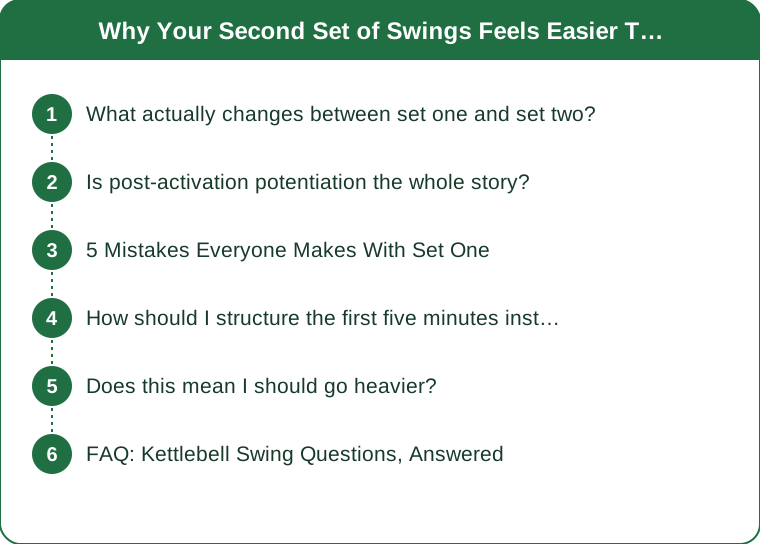
What actually changes between set one and set two?
Three things, and they move fast.
Muscle temperature. Warm muscle contracts faster and resists stretch less. A couple of minutes of swings can lift working muscle temperature by around 2 to 3C, and force output rises with it.
Neural drive. Your nervous system does not fire every available motor unit on rep one. Recruitment ramps. By the second set you are simply using more of the muscle you already had.
Motor pattern retrieval. The hinge is a skill. Set one is you remembering it. Set two is you doing it. Timing between hip snap and arm float tightens, and a well-timed swing costs less than a mistimed one at the same load.
Is post-activation potentiation the whole story?
It is a real contributor but it is not magic. Post-activation potentiation is a short-lived rise in force capacity after a demanding contraction, generally peaking somewhere between four and eight minutes after the effort and fading after that.
Swings are a good trigger for it because they are ballistic and hip-dominant. Do a hard set of ten, rest 90 seconds, and the next set genuinely has more available force behind it.
But potentiation and fatigue run on the same clock. Rest too little and fatigue wins. Rest too long and potentiation is gone. The window where set two feels best is usually 60 to 120 seconds of rest, which is why most people accidentally find it and then wonder why set five feels awful.
5 Mistakes Everyone Makes With Set One
-
Treating arm swings as a warm-up. Loose arm circles do almost nothing for a hip hinge. Warm what you are about to load.
-
Starting at working weight immediately. One set of eight with a bell 8 to 16lb lighter costs you 30 seconds and buys you a real first working set.
-
Skipping hip hinge rehearsal. Five slow deadlifts with the working bell teaches the pattern before you ask it to move fast.
-
Warming up general, testing specific. Ten minutes of walking raises your heart rate and does nothing for your posterior chain timing. Specificity beats duration here.
-
Blaming the weight. People jump up a bell size because set two felt easy, then wonder why set one gets even worse. Set one was never the load’s fault.

How should I structure the first five minutes instead?
Something like this, and it should take under six minutes:
-
90 seconds of hip hinge patterning. Bodyweight hinge with a dowel or hands on the crease, 10 slow reps. You are looking for hips back, not knees down.
-
8 to 10 deadlifts with the working bell. Slow, deliberate, full lockout. This wakes the glutes and lets you feel the load before it moves fast.
-
2 sets of 8 swings at roughly 60 percent effort. Not a working set. A rehearsal at speed.
-
60 seconds rest.
-
Then start counting. Your first working set now behaves like your old second set.
Most people find their session total goes up 15 to 20 percent in the first week of doing this, purely because they stopped throwing away one set.
Does this mean I should go heavier?
Usually not, and this is where people get themselves hurt.
If set two feels easy because you finally warmed up, going heavier means set one becomes a genuinely poor-quality heavy set, which is exactly the set where hinges turn into squats and lower backs get involved.
The test is simple. Warm up properly for a week. If sets one through four then all feel comfortably manageable at your current bell, and your last two reps are not slowing down, that is a real signal to add load. A single easy set is a warm-up artifact. Four consistent sets is a progression signal.
If you do go up, jump the bell size and drop the reps, not the other way round. Swings reward crispness, not grinding.
FAQ: Kettlebell Swing Questions, Answered
How long does the potentiation effect last in a session?
Roughly five to eight minutes after a hard set, then it fades. Across a full session, accumulated fatigue overtakes it somewhere around set four or five for most people, which is why the middle sets usually feel best.
Should my first set ever be my heaviest?
Only if you have warmed up specifically for it. A properly prepared first set can absolutely be your top set, but a cold one should never be.
Does this apply to other lifts?
Yes, and more so with technical lifts. Anything with a strong skill component, cleans, snatches, get-ups, shows a bigger set one to set two gap than a simple press does.
This is general information, not medical advice.
TL;DR:
- Set two is easier because set one was secretly your warm-up: temperature, neural drive and hinge timing all improve within minutes.
- Post-activation potentiation adds a genuine short-lived force boost, peaking around four to eight minutes and fading after.
- The fix is a six-minute specific warm-up, not a heavier bell.
- Progress load when four sets feel manageable, not when one does.
One easy set is not evidence that you are underloaded. It is evidence that your body finally showed up. Give it a reason to show up before rep one, and you get to keep the set you have been donating to the warm-up gods.
Keep Reading
This article is for general informational and styling purposes only. Fit, sizing, and product availability may vary.