Why Your Kettlebell Swing Falls Apart Specifically When You're Tired, Even With Solid Form
Quick Answer: Kettlebell swing technique commonly degrades under fatigue because the hip hinge pattern the swing relies on is largely powered by the glutes and hamstrings, and as those muscles fatigue, the body instinctively recruits the lower back and arms to compensate, turning a hip-driven movement into a more effortful, less efficient, and higher-risk one.
The first ten reps and the last ten reps can look like two different exercises entirely — and the reason isn’t a lapse in concentration, it’s the specific muscles doing the work quietly changing as fatigue sets in.

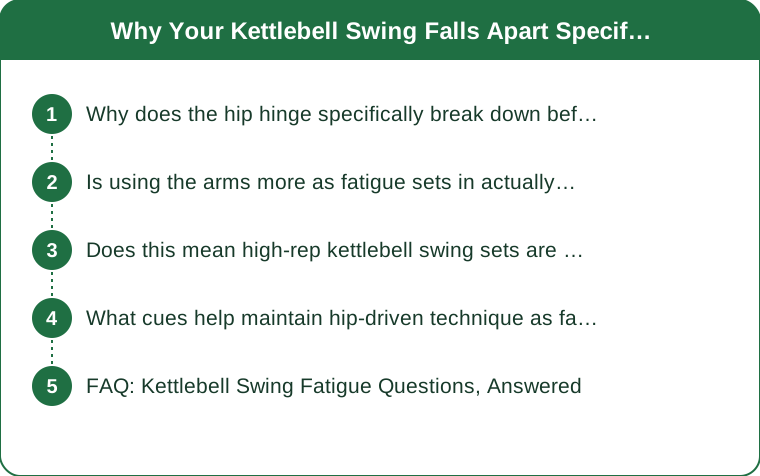
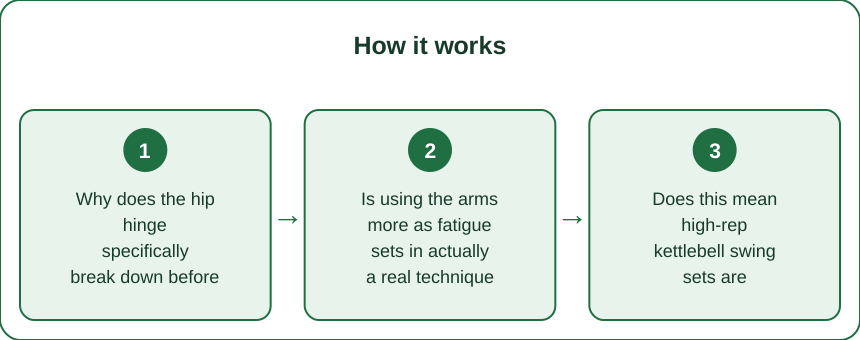
Why does the hip hinge specifically break down before other parts of the movement?
The hip hinge is the most metabolically demanding part of an efficient swing, driven primarily by fast, powerful glute and hamstring contraction — as those muscle groups fatigue over a set, the body looks for an easier path to generate the same momentum, which usually means recruiting the lower back to help extend the hips (a much less efficient and more injury-prone substitute) or using more arm-driven lifting instead of hip-driven projection.
Is using the arms more as fatigue sets in actually a real technique shift, or does it just feel that way?
It’s a measurable, real shift — a properly executed swing should feel like the kettlebell is being ‘thrown’ by hip extension with the arms staying relatively passive, but under fatigue, many people start actively lifting with the shoulders and arms to compensate for reduced hip power, which is both less efficient (using more energy for the same bell height) and puts more strain on the shoulders than the movement is designed for.

Does this mean high-rep kettlebell swing sets are inherently risky?
Not inherently, but it does mean form needs active monitoring as reps accumulate — many experienced coaches recommend stopping a set once hip-drive quality noticeably degrades rather than pushing through to a fixed rep count, since the last few reps of a fatigued set are often where the movement pattern shifts enough to meaningfully increase lower back strain risk.
What cues help maintain hip-driven technique as fatigue builds?
Focusing on ‘snapping the hips forward explosively’ rather than ‘swinging the arms up’ keeps attention on the correct power source even as it gets harder to execute — some people also find it useful to consciously reduce grip tension in the hands during the backswing, since white-knuckle gripping often correlates with a shift toward arm-driven, rather than hip-driven, movement under fatigue.
FAQ: Kettlebell Swing Fatigue Questions, Answered
Is it better to do fewer, higher-quality swings than to push through a fatigued set to hit a target rep count?
For most training goals, yes — stopping a set once hip-drive quality clearly degrades, even short of a target number, tends to produce better long-term results and considerably lower injury risk than grinding out reps with compensated technique.
Does swing weight selection affect how quickly this fatigue-related breakdown happens?
Yes — a kettlebell that’s too heavy for a given set’s target rep range causes fatigue-related compensation to appear much earlier in the set than a more appropriately sized bell, which is a common and easily fixed cause of frequent late-set form breakdown.
Should someone new to kettlebell swings avoid high-rep sets entirely until form is well established?
Generally a reasonable approach — building the hip-hinge pattern with lower-rep, higher-quality sets first, before progressing to higher-rep conditioning-focused sets, helps ensure the pattern is solid enough to hold up once real fatigue is introduced.
TL;DR:
- Kettlebell swing technique degrades under fatigue because the glutes and hamstrings driving the hip hinge tire first
- The body compensates by recruiting the lower back and arms, shifting a hip-driven movement to a less efficient, riskier one
- Stopping a set once hip-drive quality degrades matters more than hitting a fixed rep target
- Cueing an explosive hip snap and relaxed grip helps maintain correct technique as fatigue builds
The late-set sloppiness isn’t a discipline problem — it’s the muscle group doing the real work quietly changing, and quality-over-quantity rep counting is the actual fix.
Keep Reading
This article is for general informational and styling purposes only. Fit, sizing, and product availability may vary.