Why Your Kettlebell Press Fails on the Left Side First
Quick Answer: A weaker pressing side is usually a stability and rib-position problem rather than a shoulder strength problem. The dominant side has better scapular control and trunk bracing, not bigger deltoids. Train the weak side first, match its volume rather than the strong side’s, and fix the rib cage before adding load.
You press the right side for five clean reps. You switch hands and the third rep grinds, your ribs flare, and your body starts leaning like a drawbridge.
Same bell. Same shoulder anatomy. Different result every single session.
The gap is real, it is common, and it is almost never where people look for it.

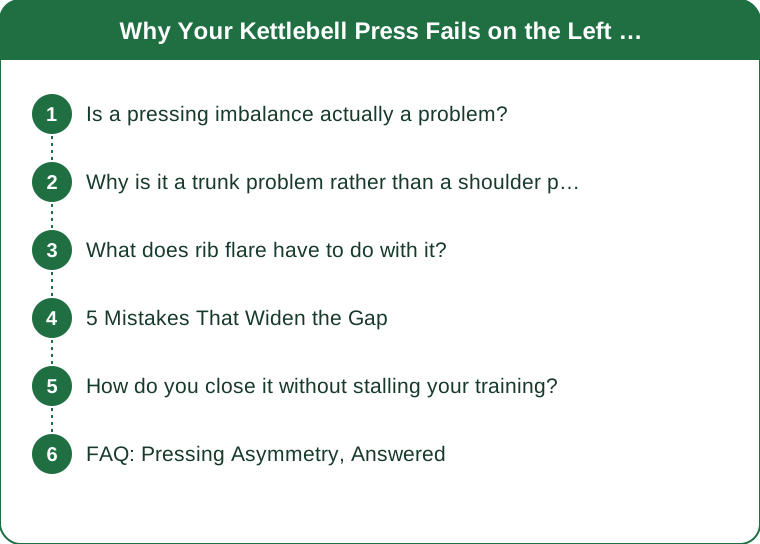
Is a pressing imbalance actually a problem?
A small one is normal. A large one is worth addressing.
Essentially everyone has an asymmetry — hand dominance affects motor control long before it affects muscle size, and decades of one-handed daily tasks build a genuine difference in coordination. A gap of one or two reps at a given weight, or one bell size, is unremarkable.
What matters is the trend and the pattern. A gap that widens as you get stronger means you are training the strong side and letting the weak one coast. A gap that appears only under fatigue points to endurance of the stabilisers rather than strength. A gap accompanied by pain is a different conversation entirely and belongs with a professional.
Unilateral pressing is valuable precisely because it exposes this. A barbell lets the strong side quietly carry the weak one. A single kettlebell cannot.
Why is it a trunk problem rather than a shoulder problem?
Because you cannot press against an unstable base, and a one-arm press is an anti-lateral-flexion exercise wearing a shoulder exercise costume.
When you press a bell overhead on one side, the load creates a bending moment on your spine toward the other side. Your obliques, quadratus lumborum and deep trunk musculature have to resist that. If they do not resist it well, your body compensates by leaning away, which changes the shoulder’s position relative to the bell and immediately reduces how much force the shoulder can produce.
The chain is: unstable trunk, lean, altered shoulder angle, weaker press. The shoulder was never the limiting factor — it just ended up in a bad position.
This is why so many people find that their weak-side press improves substantially after a few weeks of loaded carries and side planks, without doing a single extra press. They did not build shoulder strength. They built a platform.
What does rib flare have to do with it?
Everything, and it is the most visible tell.
To press overhead you need the arm to reach true vertical relative to your torso. If your thoracic mobility or your trunk control does not allow that, your body finds the range somewhere else — and the easiest place to steal it is by extending the lower back and letting the rib cage tip up and forward.
A flared rib cage puts the shoulder blade in a position where the upward rotation needed for a clean overhead lockout is mechanically restricted. You end up pressing into a partially blocked joint and calling it weakness.
The weak side is usually the side where this happens sooner, because the trunk control that prevents it is weaker there.
The check: press with your back against a wall, or better, do a half-kneeling press with your ribs deliberately held down. If the weak side suddenly cannot lock out a weight it managed standing, the standing version was borrowing range from your spine. That is not a strength gap you can close by pressing heavier.

5 Mistakes That Widen the Gap
1. Always starting with the strong side. You press the right, then the left with the fatigue of the right already present. Start every set with the weaker side, every session, for a month.
2. Matching the strong side’s reps. Doing five on the right means doing five on the left with worse quality, and reinforcing the compensation. Match the weak side instead — do what the left can do cleanly, and do that on both.
3. Chasing it with more pressing. More volume on a position problem builds a better compensation. Fix the position first.
4. Ignoring the rack. A poor rack position on the weak side means the press starts from a worse place. If the bell sits further from your body or your elbow drifts, the press was compromised before it began.
5. Never testing it half-kneeling. Standing lets your whole body cheat. Half-kneeling removes most of that and shows you what the shoulder can actually do. It is uncomfortable information and it is the useful kind.
How do you close it without stalling your training?
Run a block that treats the weak side as the programme and the strong side as maintenance.
Volume: weak side gets an extra set on every pressing exercise. Not extra weight — extra quality repetitions. Six to eight weeks.
Order: weak side first, always, in every set and every exercise.
Support work, twice a week:
- Suitcase carries on the weak side only, 30 to 40 metres, heavy enough to challenge but light enough that you do not lean. This trains the exact anti-lateral-flexion quality the press needs.
- Half-kneeling press with a deliberate rib-down brace, moderate load, focus on the lockout.
- Side plank with the top arm reaching overhead, 20 to 30 seconds each side.
Mobility, briefly: thoracic extension over a foam roller and a doorway pec stretch, 90 seconds total before pressing. Enough to allow the position, not enough to become the session.
How to know it is working: the gap should shrink in the half-kneeling test before it shrinks in the standing one. If your standing numbers converge but half-kneeling stays uneven, you have improved the compensation rather than the cause.
FAQ: Pressing Asymmetry, Answered
Should I stop pressing the strong side while I catch up?
No. Detraining one side to make them match is a bad trade, and the strong side gives you the reference for what good feels like. Maintain it with fewer sets.
Is it normal for the gap to be bigger with kettlebells than dumbbells?
Yes. The kettlebell’s offset centre of mass adds a rotational demand at the wrist and forearm that a dumbbell does not have, so any control deficit shows up more clearly. That makes it a better diagnostic, not a worse exercise.
How long should it take to close?
For a coordination and stability gap, expect meaningful change in six to eight weeks. If nothing has moved in twelve, the assumption that it is a stability problem is probably wrong and it is worth getting the shoulder looked at properly.
Does breathing matter for this?
More than people expect. Exhaling fully at the top of a press helps the rib cage settle into position, which is exactly the position the weak side struggles to find. Try a slow exhale through the lockout for a few sets and see whether the lean reduces.
TL;DR:
- A weaker pressing side is usually a trunk stability and rib position problem, not a shoulder strength problem.
- Rib flare blocks the scapular motion the lockout needs, and the weak side flares first.
- Start every set with the weak side and match its rep count rather than the strong side’s.
- Suitcase carries, half-kneeling presses and side planks close the gap faster than more pressing does.
Test yourself half-kneeling this week with a bell you can press cleanly standing. Whatever that reveals is the number your programme should be built around for the next two months.
Keep Reading
This article is for general informational and styling purposes only. Fit, sizing, and product availability may vary.