Why Your Grip Fails Before Your Legs on Heavy Swings
Quick Answer: Grip fails first on heavy swings because most people death-grip the handle through the whole rep instead of relaxing at the top, and because the forearm flexors work isometrically the entire set while the hips get a micro-rest every rep. Fix the hook grip, relax at the float, and train grip endurance separately — not by adding more swings.
The set is going great. Hips are snapping, the bell is floating, you feel like you could do this all day.
Then somewhere around rep 14 your fingers start opening on their own and the last four reps become a negotiation with a piece of metal.
Your posterior chain was nowhere near done. So why did your hands vote to end the set?

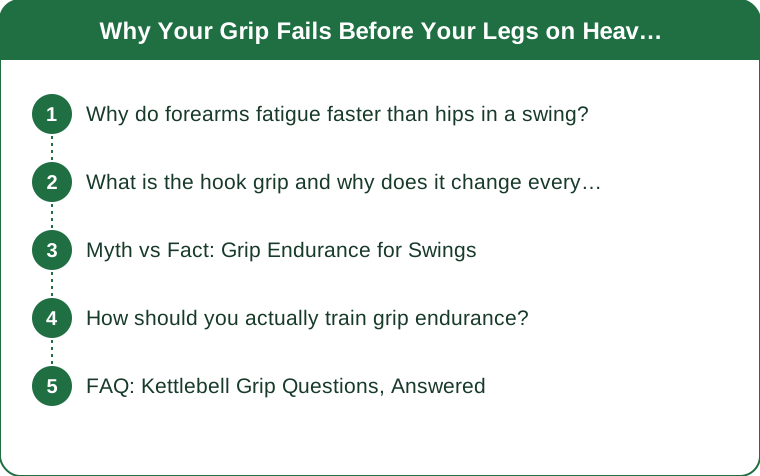
Why do forearms fatigue faster than hips in a swing?
Because they are doing fundamentally different types of work.
Your glutes and hamstrings work concentrically then rest — a hard contraction at the top of each swing, then a genuine unloaded moment as the bell floats and again as it swings back. Over a 20-rep set they get 20 short recovery windows.
Your grip works isometrically for the entire set. No unloaded moment, no recovery window, continuous oxygen demand with restricted blood flow because a sustained contraction compresses the vessels running through the forearm.
That is why a 20-rep set feels like 20 efforts to your hips and one continuous 40-second effort to your hands. The mismatch is structural, not a sign that you are weak.
What is the hook grip and why does it change everything?
Most people hold a kettlebell like a suitcase — handle in the palm, full crush grip, thumb wrapped tight. That recruits maximum forearm effort for every single second.
The hook grip puts the handle in the fingers, not the palm. Curl your fingers around it like a hook on a coat rack, keep the thumb loose or resting over the fingers, and let the bell hang from the second knuckle line.
Two things improve immediately. Forearm demand drops significantly because you are using tendon and skeletal structure rather than pure muscular clamping. And the bell can rotate slightly in your hand during the float, which stops the handle from twisting against locked skin — the cause of most blisters and torn calluses.
At the top of every swing, deliberately relax your hands for a beat. The bell is weightless there. Those micro-relaxations across a set add up to real recovery.

Myth vs Fact: Grip Endurance for Swings
Myth: If your grip fails, use straps and keep training the hips.
Fact: Straps have a place in deadlifts, but in swings they remove your ability to release the bell, which is a genuine safety issue. Fix the grip mechanics first.
Myth: More swings will build the grip you need.
Fact: Swings train grip in a specific, dynamic, short-duration pattern. Sustained holds train a different quality. Farmer carries and dead hangs build grip endurance faster than more swings do.
Myth: Chalk is for competitors.
Fact: Chalk is for anyone whose hands sweat. Moisture is the single biggest cause of grip slipping in a warm room, and a $6 block lasts a year.
Myth: Thicker handles are better for grip development.
Fact: Thicker handles are harder, which is not the same as better. A handle diameter above about 38mm shifts a swing into a grip exercise with a hip warm-up attached.
How should you actually train grip endurance?
Separately, and not to failure every time. A simple weekly structure:
- Farmer carries: 3 rounds of 40 meters with the heaviest bells you can hold without shrugging. Rest 90 seconds. Twice a week.
- Dead hangs: 3 sets of 20 to 40 seconds from a pull-up bar. This trains the same sustained isometric quality a swing set demands.
- Bottoms-up carries: one round of 20 meters per side. Brutal for grip at surprisingly light weight, and it also builds shoulder stability.
Do these after your swings, never before. And skip a session if your hands are still tender — calluses that tear set you back two weeks.
One practical note: file your calluses. A raised callus is what catches and rips. A flat one is armor.
FAQ: Kettlebell Grip Questions, Answered
Should I chalk or use gloves?
Chalk. Gloves add a layer of material that bunches in the palm and effectively increases handle diameter, which makes grip harder while feeling protective.
Is it okay to switch hands mid-set?
Yes, and for single-arm work it is ideal — alternating gives each forearm a genuine rest window and lets you extend total working time without extending fatigue.
My grip is fine but my thumb aches after swings. Why?
Usually a crushed thumb wrap. Try resting the thumb over the fingers rather than under the handle, and check that the handle is sitting in the finger hook rather than deep in the palm.
TL;DR:
- Grip works isometrically all set while hips get a micro-rest every rep
- Switch to a hook grip in the fingers and consciously relax at the float
- Chalk beats gloves, and thicker handles make it harder, not better
- Build grip endurance with farmer carries and dead hangs, not more swings
Try one set with a deliberate hand relaxation at the top of every rep. Most people add four to six reps before their hands complain, without changing anything about their hips.
Keep Reading
This article is for general informational and styling purposes only. Fit, sizing, and product availability may vary.