Why Kettlebell Swings Feel Completely Different Barefoot
Quick Answer: Cushioned running shoes compress under the heel during the backswing, which shifts your weight forward and turns a hip hinge into a squat. Barefoot or flat-soled shoes keep the heel stable, so you can push the floor away and load the hamstrings properly. If your swings suddenly feel more powerful barefoot, that is the heel drop, not your imagination.
Most people fix a stubborn swing faster by changing footwear than by changing cues.
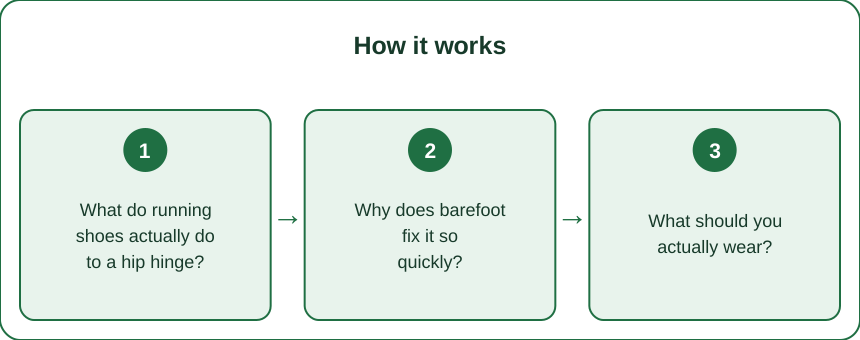
What do running shoes actually do to a hip hinge?
They tilt you forward and then move underneath you, both of which sabotage the movement.
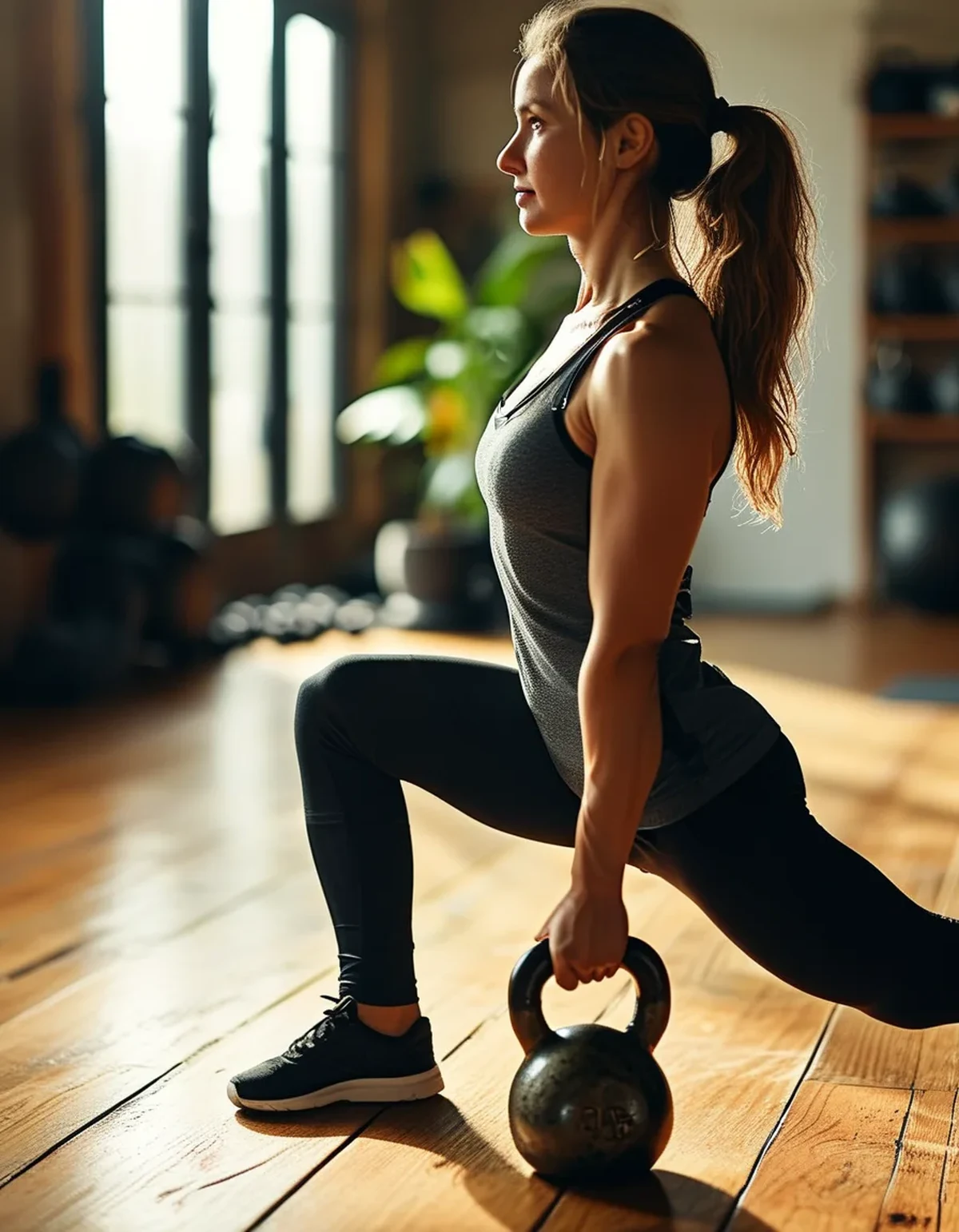
A typical running shoe has a heel-to-toe drop of 8 to 12 millimetres and a compressible foam midsole under the heel. Standing still, that feels like nothing. Loading a hinge with 16 or 24 kilograms of kettlebell swinging backward between your legs is a different situation entirely.
Two things happen:
The drop pre-tilts you. Elevated heels shift your centre of mass forward, which means you start the hinge already leaning toward your toes. The swing pattern needs weight through the midfoot and heel so the hips can travel backward. Starting forward means you either fight the shoe the whole set or you compensate by bending the knees more - which is exactly how a swing turns into a squat.
The foam compresses unevenly. During the backswing the load spikes through the heel, and soft foam yields. Your foot is now on a slightly moving surface at the precise moment you need a stable base to redirect force. You cannot push hard against something that gives. Power that should go into hip extension goes into compressing foam instead.
The result is a swing that feels vague. The bell floats rather than snapping, the hamstrings feel underused, and the quads and lower back pick up the slack. People usually diagnose this as a technique problem and add cues, when the surface underneath them is the actual variable.
Why does barefoot fix it so quickly?
Three reasons, and the third one is underrated.
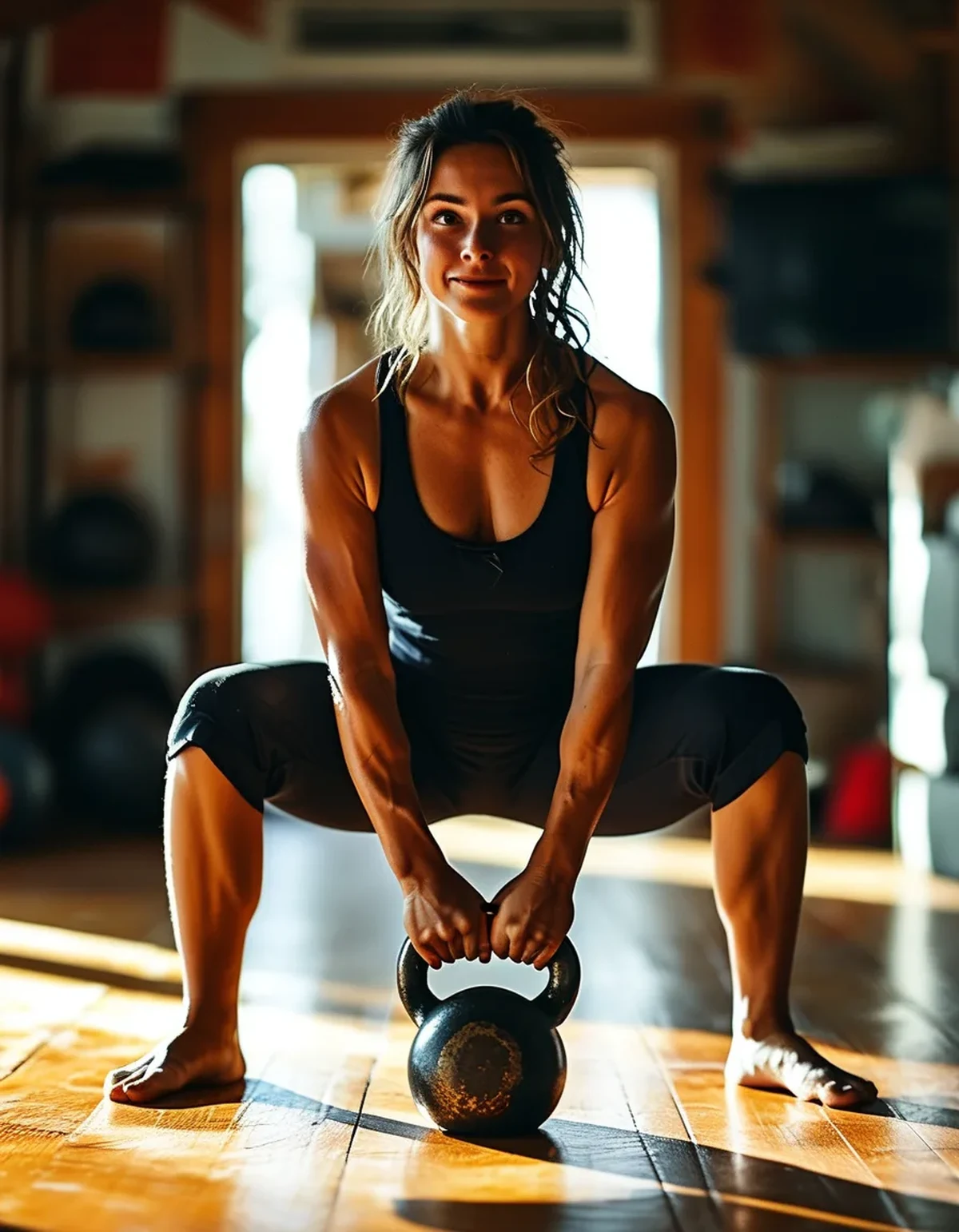
Zero drop puts your weight where the hinge needs it. With a flat foot, the natural distribution sits over the midfoot and heel. That is the position from which the hips can travel back without the knees taking over, and it is available immediately rather than after ten reps of adjusting.
A rigid surface returns force. Bare feet on a hard floor mean everything you push goes back into hip extension. Lifters describe this as the bell suddenly feeling lighter at the top, and mechanically that is roughly what is happening - less energy is being absorbed before it reaches the bell.
Your foot can actually grip. Toes spread, the arch engages, and the whole foot participates in stabilizing. Inside a cushioned shoe with a narrow toe box, none of that is possible. The foot is a sensory organ as much as a support, and covering it in foam removes information your nervous system uses to organize balance. This is why barefoot swings often feel more controlled at the bottom of the backswing even before they feel more powerful.
Worth being honest about the limits. Barefoot is not automatically superior for everything - if you have plantar fasciitis, diabetic neuropathy, or you train on a floor where dropping a bell is a real possibility, shoes are the sensible call. And if you have spent twenty years in cushioned shoes, going straight to barefoot for heavy sets is a good way to give your calves and arches a rough week.
What should you actually wear?
The specification is simple: flat, thin, wide, and stable.
Zero to 4 millimetre drop. Flat enough that your heel and forefoot sit at effectively the same height.
Firm sole. You want to feel the floor. Press your thumb into the heel of the shoe - if it sinks noticeably, it will sink under load.
Wide toe box. Toes need room to spread for balance. This is where most cross-training shoes still fall short.
Flexible enough to feel the ground, rigid enough not to fold. A thin rubber sole hits this balance; a foam one does not.
What works, roughly in order of how well it suits swings specifically:
- Barefoot - best feedback, best force transfer, no protection
- Minimalist or barefoot-style shoes - nearly the same benefits with toe protection
- Wrestling or boxing shoes - flat, thin, grippy, and inexpensive
- Deadlift slippers - purpose-built for exactly this, though they offer no lateral support
- Flat-soled canvas shoes - the budget standard, and perfectly adequate
- Weightlifting shoes with a raised heel - actively wrong for swings, despite being right for squats
- Running shoes - the worst option, and the most commonly worn
A sensible transition plan if you are coming out of cushioned shoes: start with your warm-up sets barefoot only, for two weeks. Then add your first working set. Add one set per week after that. Expect calf and arch soreness in the first two weeks - that is adaptation, not injury, unless it is sharp or persists past a session.
5 Mistakes People Make With Kettlebell Footwear
1. Wearing squat shoes for swings. The raised heel that helps you reach depth in a squat actively works against a hinge. If you train both in one session, the raised heel is the wrong compromise - do the swings first in flats.
2. Going fully barefoot on day one with heavy bells. The feet and calves have been supported for years. Give them two to three weeks of gradual exposure before loading heavy, or you will spend a week limping and blaming the swing.
3. Confusing thick with protective. A thick foam sole protects nothing if a bell lands on your foot and destabilizes you on every single rep in the meantime. Thin and firm is the safer trade for this movement.
4. Assuming socks are the same as barefoot. Socks on a smooth floor are a genuine hazard - the whole benefit is grip and feedback, and socks remove both while adding slip. Barefoot or thin shoes, not socks.
5. Never questioning footwear at all. People spend months troubleshooting a swing that will not click, adding cues about packing the lats and hiking the bell, while standing on 10 millimetres of compressible foam. Try one session barefoot before you rebuild your technique.
FAQ: Barefoot Kettlebell Training Questions, Answered
Is barefoot training safe with heavy kettlebells?
With good bell control, yes, and it is what most kettlebell coaching traditions default to. The risk is dropping a bell on an unprotected foot, so if your grip fatigues badly or you are learning cleans and snatches, thin-soled shoes are the reasonable compromise.
Will barefoot swings strengthen my feet?
They load the intrinsic foot muscles and arch in a way cushioned shoes prevent, and most people notice better balance within a few weeks. Treat it as a slow adaptation rather than a training goal in itself.
What if my gym does not allow bare feet?
Most do not, for hygiene and liability reasons. Minimalist shoes, wrestling shoes, or deadlift slippers give you nearly all the benefit and satisfy the rule.
Does this apply to other kettlebell movements?
Yes, and more so to anything hinge-based - deadlifts, cleans, snatches, and swings all want a stable heel. Turkish get-ups also benefit, since so much of the movement is about knowing where your foot is.
I have flat feet. Should I still try this?
Proceed carefully and slowly, and stop if you get arch or heel pain that lasts beyond the session. Some people with flat feet do very well with gradual barefoot exposure and some do not, and a podiatrist is better placed to advise than a general article. This is general information, not medical advice.
TL;DR:
- Cushioned running shoes tilt you forward and compress under load, turning a hinge into a squat.
- Barefoot or flat shoes keep weight over the midfoot, return force efficiently, and let the foot grip and sense the floor.
- The specification is flat, thin, wide, and firm - wrestling shoes, deadlift slippers, or minimalist trainers all work.
- Raised-heel weightlifting shoes are right for squats and wrong for swings.
- Transition over two to three weeks. Expect calf and arch soreness early on.
Before you rebuild your swing technique, try one session barefoot. It is a five-second experiment that solves a surprising number of stubborn swings.
Keep Reading
This article is for general informational and styling purposes only. Fit, sizing, and product availability may vary.