The Swing Clinic: Fixing the Five Most Common Kettlebell Mistakes
Quick Answer: Five errors account for almost every bad swing: squatting instead of hinging, lifting the bell with your arms, not standing fully at the top, letting the bell drop too low on the backswing, and holding your breath. Each has a one-sentence fix. A corrected swing feels completely different — the bell floats, your glutes burn, your shoulders don’t — so you’ll know within about five reps whether it worked.
The kettlebell swing is the best exercise most people are doing wrong.
Not slightly wrong. Wrong in a way that turns a glute and hamstring exercise into a quad-and-shoulder exercise with a sore lower back attached.
The good news is that the errors are remarkably consistent. There are five of them, they each have one cue, and the corrected version feels so different that the fix confirms itself.

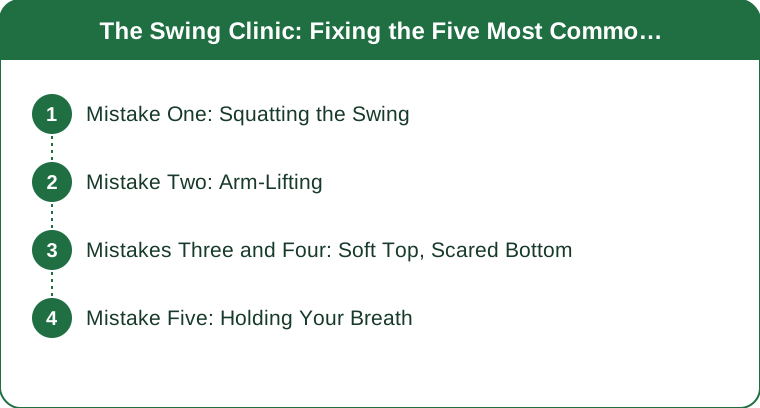
Mistake 1: Are you squatting the swing?
The single most common error, and it changes which muscles do the work entirely.
The swing is a hinge, not a squat. In a hinge, your hips travel backward and your shins stay close to vertical. In a squat, your knees travel forward and your hips travel down. If your knees are moving forward on the backswing, you’re squatting.
The fix — “close the car door with your butt.” Stand about a foot in front of a wall, push your hips straight back until they touch it, and notice how little your knees bend. That’s the movement.
Second cue — “attack the zipper.” The bell should sweep back high, up close to your hip crease, not down between your knees toward the floor. A bell traveling low means you squatted to make room for it.
The tell: squat-swings tire your quads. Hinge-swings light up your glutes and hamstrings. If your legs are burning in the front, check this first.
Mistake 2: Are you lifting the bell with your arms?
Your arms are ropes. Your hips are the engine.
The bell should float up to roughly chest height from the hip snap alone — you’re not raising it, you’re letting momentum carry it and then guiding it back down. At the top of a proper swing, your grip is loose enough that the handle is barely held.
The fix: snap your hips hard and deliberately let the bell surprise you. Don’t help it. The first few reps will feel like you’re not doing enough, which is precisely the point.
The tell: if your shoulders are the sorest thing the next day, you performed a front raise with extra steps. Shoulders should be almost untouched by swings.

Mistakes 3 and 4: The soft top and the scared bottom
These two are opposite ends of the same rep, and they usually appear together.
The soft top. At the top of the swing you should be standing completely upright — glutes squeezed hard, abs braced, body forming a straight line from heel to head. Most people stop at about 80% of standing, which leaks power out of every single rep and means the glutes never fully contract.
Cue: proud top. Think “stand up like someone just called your name.”
The scared bottom. The opposite problem: letting the bell drift low and slow on the backswing, usually because it feels safer. It isn’t. A low backswing pulls your torso forward and drags your spine toward rounding, which is where most swing-related back complaints come from.
Cue: high backswing. The bell stays up near your hips, the movement is fast, and the transition from back to forward is sharp rather than drifting.
Proud top, high backswing. Those four words fix most of what’s left after the hinge.
Mistake 5: Are you holding your breath?
Almost everyone does, and it’s why set ten feels considerably worse than it should.
The swing has a breathing rhythm built into it: a sharp exhale at each hip snap — a short “tss,” like a bike pump — and an inhale on the backswing. One breath per rep, timed to the movement.
Breath-holding through 10 or 15 swings produces dizziness, a spike in blood pressure, and a much faster drop in performance than the workload justifies.
The swing has a soundtrack. Join it.
A note on balance: these are general coaching cues, not individual instruction. Start with a weight you can hinge cleanly with — commonly 8–12 kg for women new to the movement and 12–16 kg for men, though it varies widely — and learn the hinge without a bell first. See a professional — a qualified coach for form, or a physician or physiotherapist for pain — if you have an existing back, hip, or shoulder injury, if you’re pregnant or postpartum, or if any swing produces sharp pain rather than muscular fatigue.
5 Mistakes Everyone Makes
- Squatting instead of hinging. Hips back, shins vertical, bell sweeps high toward the zipper.
- Lifting with the arms. Arms are ropes. If your shoulders are sore, that was a front raise.
- Not standing fully at the top. Glutes squeezed, body a plank. Stopping at 80% leaks every rep.
- A low, scared backswing. Keep the bell high near the hips. Low backswings round the spine.
- Holding your breath. Sharp exhale on the snap, inhale on the backswing, one breath per rep.
FAQ
Why does my back hurt after kettlebell swings?
The usual culprits are squatting the movement instead of hinging, or letting the bell drop too low on the backswing — both pull your torso forward and load the lower back rather than the glutes and hamstrings. Rounding at the bottom of the swing is the specific mechanical fault. If correcting the hinge and raising the backswing doesn’t resolve it within a session or two, stop and get it assessed rather than working through it.
How high should a kettlebell swing go?
To about chest height for a standard Russian swing, and it should get there from hip drive alone rather than from lifting. Height isn’t the goal — the float is. If you have to pull the bell up to reach chest height, the weight is too heavy or the hip snap isn’t sharp enough.
What weight kettlebell should a beginner use for swings?
Heavier than most people expect, because a bell that’s too light encourages arm-lifting instead of hip drive. Common starting points are 8–12 kg for women and 12–16 kg for men, adjusted for training background. The right weight is one you can hinge cleanly with for 10 reps while still feeling the hips do the work.
TL;DR:
- The swing is a hinge, not a squat — hips back, shins vertical, bell sweeps high toward the hip crease.
- Arms are ropes. The bell floats to chest height from hip snap alone.
- Stand fully at the top: glutes squeezed, body a plank.
- Keep the backswing high and fast; a low, drifting bell rounds the spine.
- Sharp exhale on each snap, inhale on the backswing.
- Sore quads or sore shoulders means you’re doing a different exercise. Sore glutes means you got it.
- Get form checked and stop for sharp pain — these are general cues, not individual instruction.
Keep Reading
This article is for general informational and styling purposes only. Fit, sizing, and product availability may vary.